MastChain Token Model
The MAST token exists to reward people who help build reliable AIS coverage. The model is designed to be simple to understand while still supporting long term value for contributors and the wider ecosystem.
The token model is built around a few core ideas.
- Rewards come from a fixed pool so the supply enters the network in a predictable way.
- Stations are rewarded for real, reliable AIS coverage.
- Devices must show they are online and healthy.
- A share of data revenue is used to buy and burn MAST, reducing supply over time.
These ideas create a system that is fair for contributors and aligned with the growth of the network.
How the token supply is allocated
The MAST token is divided into several groups that support growth and stability:
Supply: 500Million MAST
| Allocation Category | Percentage |
|---|---|
| Rewards | 65 percent |
| Core team and advisors | 10 percent |
| Ecosystem growth | 10 percent |
| Exchange liquidity and market support | 5 percent |
| Project reserve | 5 percent |
| Presale or fundraising | 5 percent |
This mix ensures that most of the supply is focused on rewarding contributors, while still giving the project the resources it needs to develop and scale.
How new tokens enter circulation
The primary way for tokens to enter circulation is via the Reward pool: stations providing data for the network receive a daily reward for their contribution, as long as certain criterias are met.
Proof of Coverage
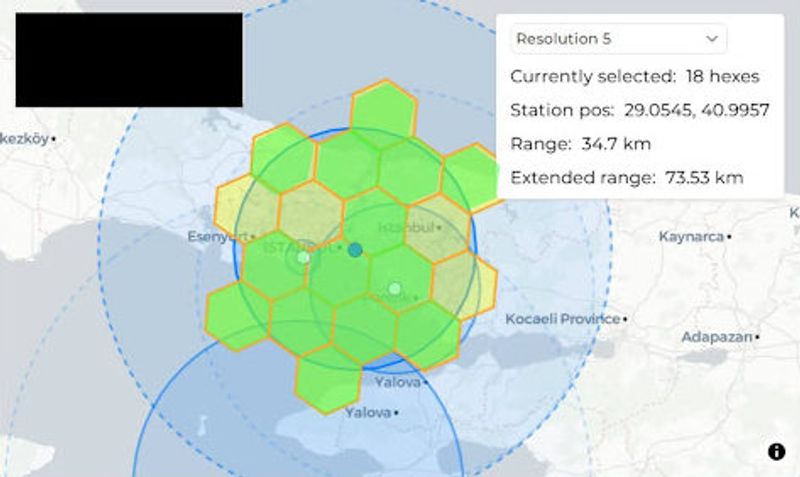
MASTCHAIN uses PoC (Proof of Coverage) The world is divided into hex shaped map tiles. A station earns from a hex when it contributes enough valid AIS messages inside that area during the day (highlighted green in the below image).
A single station can earn from many hexes if it covers a wide area. Coverage is checked for each hex separately, so stations that cover multiple areas are rewarded fairly.
Base Rewards and Halving Cycle
The amount of MAST tokens received daily for a station covering a single hex, before bonuses and slashing, is called the “Base Reward”.
To support the long term health of the system, the Base Reward rate slowly steps down over time. Every two years the daily reward amount is cut in half. This protects the value of rewards as the network grows.
The Base Reward for the first year is fixed at 0.223
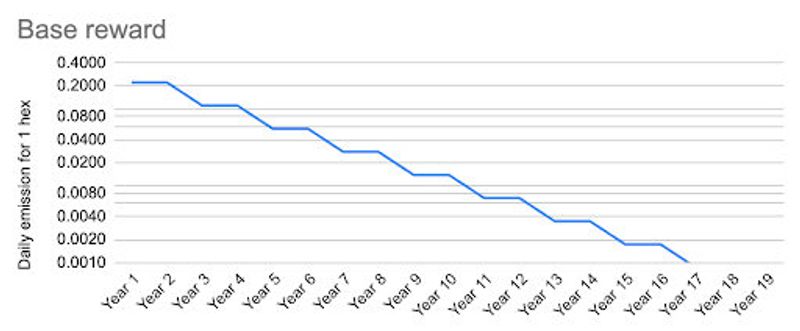
Each day the network releases a small and predictable amount of new tokens, proportional to the amount of hex tiles that have been capturing marine traffic. This creates a steady reward system, incentivizing early adopters while also ensuring a negative inflation over time.
The goal is simple. Create reliable, long term incentives without inflating the circulating supply too quickly.
Bonuses and slashing
Uptime and heartbeat
For a station to earn rewards, it needs to show that it is reliably online.
Each device sends a small signed heartbeat once per minute. Missing heartbeats reduce the daily uptime score. A station needs at least eighty percent uptime to qualify for rewards.
Higher uptime earns bonus rewards: above 95% uptime the station get a bonus of +100% (compared to Base Reward) for all hex tiles
This makes stable installations more valuable to the network.
Note: all bonuses are additive against the base amount, they do not compound on each other.
Bonding
Each station keeps a small amount of MAST locked as a bond. This creates a basic safeguard against abuse. If a node in the network is seen to act maliciously, the staked MAST is slashed and those tokens are lost. Continual slashing may lead to removal from the network.
For a user to receive rewards from the network, their account must first reach a minimum bond amount. Once the bond threshold is reached, the user can withdraw the rewards over the bond threshold to their own wallet.
If a station behaves honestly, the bonded amount can be withdrawn from the network, however a 28 day period is applied to the withdrawal.
Bonuses and special incentives
Bonuses allow the team to direct capital where it creates the most value. These bonuses are additive on top of the base reward for a hex and are computed against the base amount, not against each other. There are three categories.
- Referral bonuses: Referral bonuses can be granted to a contributor who brings in other active stations. The referral percentage is set per account and capped at 50%t of the base reward.
- Area-of-interest bonuses: Area of interest bonuses can be attached to designated hexes and can be as high as 200% of the base reward for those hexes. These bonuses are time bound and are intended to seed critical corridors, chokepoints, or regions with sparse data.
Because all bonuses are additive against the base amount, they do not compound on each other.
How the token captures value
MASTCHAIN earns revenue by selling AIS data to enterprise customers. These buyers pay in fiat currency.
A share of this revenue is used to buy MAST tokens on the open market. The tokens purchased are permanently removed from circulation. This creates steady long term scarcity and links the value of the token to the success of the data business. Burn address and amounts are visible on the blockchain.
Final Comments
Good placement makes a real difference. Stations with a clear view of the water, minimal obstacles and open horizons tend to pick up more AIS signals. This increases the number of hexes you can cover and strengthens your daily rewards.
Consistency also matters. A receiver that stays online through the full day will outperform a nearby station that drops offline or loses signal. Stable uptime helps you qualify for bonuses and ensures you make the most of each reward window.
If you set up your station in a strong location and keep it running reliably, you will contribute meaningful coverage to the network and earn more from your participation.